Projects
My research has been aimed at better integrating natural philosophy into the history of the Enlightenment.
Typically, ‘the Enlightenment’ is seen as advancing a secularising, reformist agenda towards improving the material and moral condition of society through the exercise of reason and the rejection of received intellectual authority. If considered relevant to this endeavour, the study of nature is viewed as an outside influence, not integral to Enlightenment thought per se.
My work has sought to show how the eighteenth century witnessed major conceptual innovation in natural inquiry that was integral to eighteenth century philosophy and crucial to the emergence of modern science.
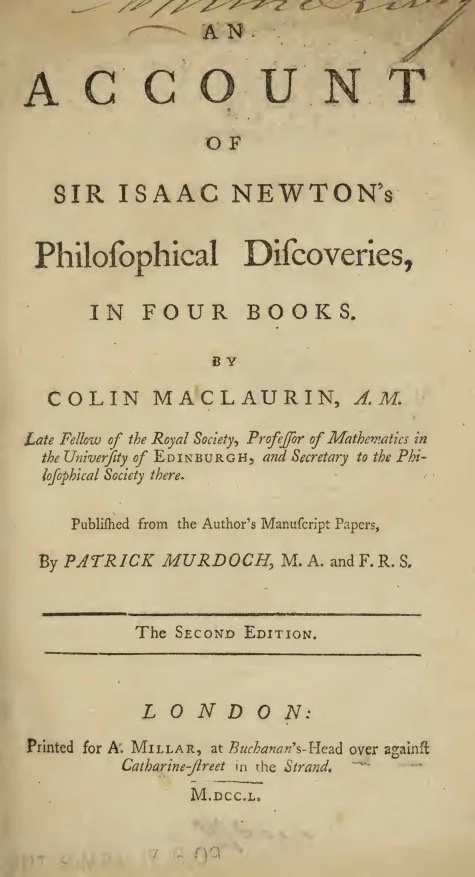
The Reception of Isaac Newton in Enlightenment Scotland
My doctoral research investigated how Isaac Newton’s example functioned in a range of debates that cut across several fields of inquiry. While Newton’s ideas are often treated as a static scientific ideal that inspired Enlightenment philosophers, I show how Newton’s work catalysed crucial intellectual developments in Scotland that had important consequences for a range of concerns characteristic of Scottish Enlightenment philosophy, such as moral philosophy (ethics), the science of the mind (psychology), and historiography. I have developed a new understanding of ‘Newtonianism’ as a dynamic set of responses to Newton’s philosophy, primarily regarding causation and method.
Central aspects of Newton’s philosophy were subject to varying interpretations that offer valuable insight into how natural philosophy was conceived from the late seventeenth to the early nineteenth century. I have found that ‘Newtonian natural philosophy’ underwent significant transformation in Scotland, largely in response to new ideas about the relationship of God to nature and new theories describing how the mind works, a finding which I think helps us better understand the origins of the more recognisably modern science of the nineteenth century. I have also sought to counter the widespread misconception of Newton’s Scottish admirers as partisan followers by foregrounding their ideas and revealing how they both engaged critically with Newton’s writings and frequently disagreed about (and with) Newton.
The research for this project was undertaken at the School of History, Classics and Archaeology, University of Edinburgh (2019–23).
Get in touch
Send me a message if you’d like to discuss a project or find out more about what I do.